The growth of the Indian middle class, over the past two decades, can be attributed to the opening up of markets, leading to more disposable incomes in the families. Families started to look beyond the proverbial ‘Roti- Kapda- Makaan‘ (Food-Clothing-Shelter). This growth was manifested in form of aspirational items. One such aspirational item was a ‘family gaadi‘ (family vehicle). As Delhi is a metro city, with a growing population, and a growing middle class, I chose Delhi to analyze this symbol of middle class aspiration.
So I started looking for data related to motor ownership, and I did find some useful data. I found vehicle ownership data from 2001-2012. The data was split into separate files, but the data quality was ok. The files had a lot of data, with three levels of granularity (i.e. Type –> Vehicle Category –> Type Of Vehicle). Here is an example
- Type = Commercial Vehicle
- Vehicle Category = Taxi
- Type Of Vehicle = Motor cabs/ Maxi cabs/ Other taxi (I have no idea what is the difference between these three types of taxi)
As I wanted to only analyze the middle class vehicles, I concentrated on ‘Scooter’, ‘MotorCycle’, and ‘Car’. But to give a bigger picture for comparison, I kept some cumulative numbers too, at the bottom half of the visualization (Total Commercial and Non-Commercial vehicles).
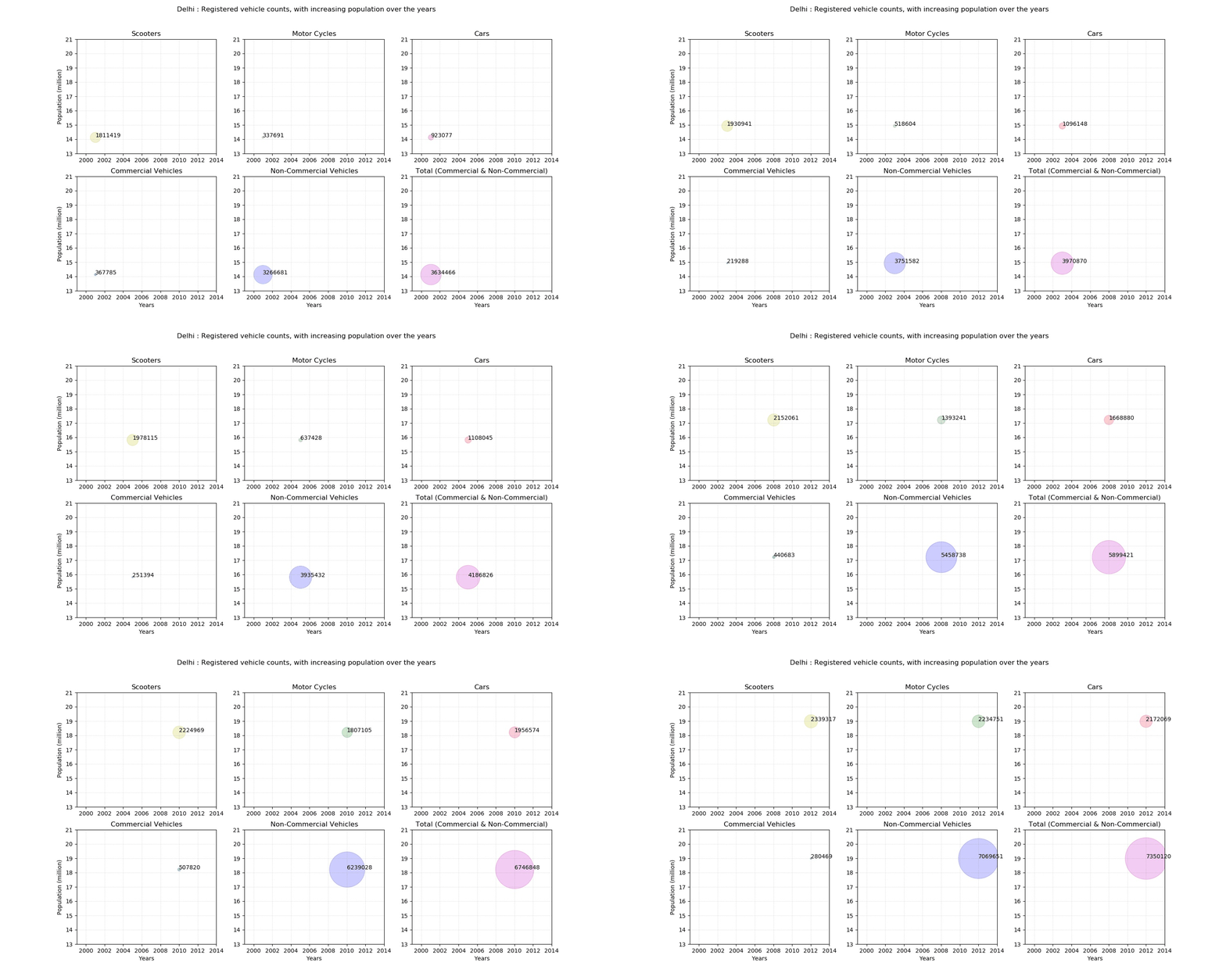
x-axis shows the year(2001-2012)
y-axis shows the population of Delhi
Scooter was the ultimate symbol of a middle class family. It was a common sight to see, with a family of four going around the roads. The father would be driving the scooter on the front seat, and the mother would be sitting on the rear seat with both legs on one side, resting on a foot rest. younger kid would be standing in front (between the handle and the front seat), with a instruction to keep away from the foot break pedal. The elder kid would be sitting sandwiched between the father and the mother.
Scooters have maintained their popularity over the years, which can be clearly seen by the nearly constant circle size in the above visualization. I remember the olden days of scooters in India. Few milestones which I remember in the scooter’s journey in India are as follows :-
- Lambretta – They were one of the initial brand of scooter to be sold in India. I am talking ’80s. There were only few seen on the roads.
- Bajaj Chetak – This was the scooter which became very famous, and truly became the first aspirational vehicle of a family
- LML Vespa – This scooter tried to challenge chetak’s monopoly. It was also a geared scooter like chetak, but was much better looking. Unlike chetak, the vespa’s stepeny (spare tyre, for non Indians) was hidden inside the body of the scooter.
- Kinetic Honda – This was the first non-geared scooter which got famous in India. It created a whole new segment of scooters.
- Bajaj Scooty – The scooty got very famous, specially among the girls. It was lighter that kinetic honda, cuter looking, smaller body, and a smaller engine. Though it didn’t last very long, but the name stuck. I still see people referring to any non-geared scooter as a scooty. It became the segment name.
- Honda Active – This was the last milestone in the scooter story, after which many companies starting selling non-geared scooters.
Motor Cycles were not very famous in the initial years. They were initially more of a niche vehicle (considered as a “man’s two wheeler”), and a middle class family buying their first two wheeler mostly preferred a scooter over a motorbike. But over the years the popularity of motor cycles has grown, as can be seen in above visualization’s circle size increase for the motor cycles.
As motor cycles have caught middle class’s fancy only in the recent years, there aren’t many milestones I remember. Initially (’80s) there were brands like Java, Yezdi, and Enfield. Then lighter bikes (remember Yamaha RX100 ?) became famous. With the growing interest of people in motorcycle, over the recent years, several brands have come into the motorcycle business.
Cars slowly became famous, over the years. They were the ‘one step up’ from a scooter, for a family. Cars symbolized prosperity in a middle class family. Cars have grown from ‘one in a locality’ to ‘one per family’ in the middle class clusters of the cities. This can clearly be seen by the increase in circle size of cars, in the above visualization.
Initially, vary few car brands were there (‘Premier Padmini’, and ‘Ambassador’), and very few cars were sold. The cars got famous only with the launch of ‘Maruti Suzuki 800’. It became the ultimate aspiration for many middle class families. I don’t think that any other car has as big of an impact on the ‘wants’ of Indian people, as did the 800. Slowly with increasing prosperity of the middle class, number of car buyers kept on increasing, and so did the car brands and models.
Honorable mention : There is one more vehicle type, which deserve a mention. I did have the data for it, but I didn’t put them in the visualization as they couldn’t sustain to be the symbols of middle class aspirations. I am talking about the ‘Mopeds‘. Mopeds were two wheelers which fell between scooters and motorcycles. They were quite famous in the ’80s and ’90s, but fizzed out after that. The only famous brands which I remember were ‘Avanti Garelli’, ‘Kinetic Luna’, and ‘Hero Puch’.
With the burgeoning middle class population of India, the market for scooters, motorcycles, and cars is continuously growing. More companies are entering the Indian market with their vehicles, which are more cost effective, fuel efficient, and environment friendly. This is good news for the Indian middle class family …